Most of us know Florence Nightingale as the Lady with the Lamp, the woman who turned nursing from an unregulated, low-status job into a respected medical profession. But far fewer can answer the question what war did Florence Nightingale nurse in, or understand how that conflict shaped every part of her lasting legacy. If you're a student researching her life, a nursing professional curious about your field's origins, or just a history buff filling in gaps, this guide breaks down everything you need to know, plus the less-told stories of her work on the front lines.
What War Did Florence Nightingale Nurse In? Full Context of Her Deployment
The short answer is the Crimean War, a conflict fought between 1853 and 1856 by an alliance of France, the Ottoman Empire, the United Kingdom, and Sardinia against the Russian Empire. Nightingale was 33 years old when she received an official request from Secretary of State for War Sidney Herbert to lead a team of nurses to care for wounded British soldiers stationed in Ottoman territory. She didn't just accept the request without conditions, either. She negotiated full authority over the nursing team, which was almost unheard of for a woman in a military role at the time, and insisted on bringing only nurses who had completed formal training, even if that meant turning down volunteers from wealthy families who wanted to join for social status. She had already spent years studying nursing against her wealthy family's wishes, so this deployment was her first chance to test the systematic care practices she'd developed in private hospitals across Europe. You might see some sources incorrectly link her to other 19th century conflicts like the First Opium War, but those claims are unsubstantiated—her only active wartime service was during the Crimean campaign.
How Wartime Conditions in Crimea Shaped Her Revolutionary Care Practices
When Nightingale and her team of 38 nurses arrived at the Barrack Hospital in Scutari (now part of Istanbul) in 1854, they found facilities on the brink of collapse. Soldiers were dying from preventable diseases like typhus, cholera, and dysentery at 10 times the rate they died from combat wounds when she first arrived, a statistic that shocked even the most experienced members of her team. Many military officials pushed back against her changes at first, arguing that hygiene was irrelevant to patient outcomes and that she was overstepping her role as a nurse. But once she started implementing protocols and tracking results, the data spoke for itself. The core reforms she rolled out in Scutari included:
That record-keeping work is part of why her reforms spread so quickly after the war ended. She didn't just make changes and assume they worked—she collected hard data to prove that her hygiene protocols cut mortality rates by 75% in less than two years of her being stationed at Scutari. Even her harshest military critics had to concede her methods were effective once they saw the numbers.
Lesser-Known Stories of Her Work During the Crimean War
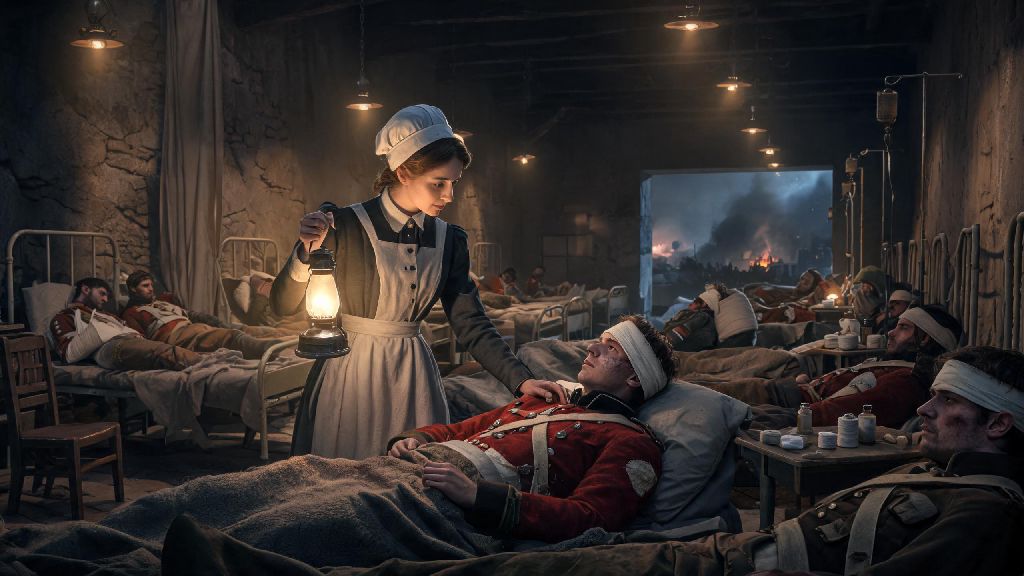
Most pop culture depictions of Nightingale only focus on her making rounds at night with her lamp, checking on patients after the rest of the staff had gone to bed. But there are dozens of less-told stories that show how much more she contributed to the war effort beyond direct patient care. She spent a large portion of her own personal fortune, more than £45,000 in today's currency, to fund hospital supplies and support services for soldiers when the British military refused to allocate extra budget for care. She also earned the nickname "Lady with the Lamp" from the soldiers themselves, who would watch her walk the 6 kilometers of ward halls every night, checking on patients who were often separated from their families for years at a time. Many soldiers wrote letters home about her kindness, and she personally helped hundreds of men send messages to their loved ones back in the UK when they were too sick to write themselves.
She also set up a dedicated education center for soldiers on the base, offering free reading and writing classes to enlisted men who had never had access to formal education before the war. Many people also don't know that she contracted a severe bacterial infection called brucellosis while stationed in Crimea, which left her bedridden for nearly 30 years after she returned to the UK. Even then, she continued to write and advocate for public health reform from her home, pushing for better hygiene standards in hospitals and workhouses across the British Empire. Her work during the war didn't just save lives in the short term—it laid the groundwork for the modern infection control practices that keep patients safe today.
How Her Wartime Service Changed Nursing and Public Health Forever
Before Nightingale's deployment to Crimea, nursing was seen as a job for working-class women with no formal training, and it was often associated with low moral character in popular culture. She completely flipped that narrative by proving that trained, professional nurses could drastically reduce patient mortality rates, even in the most challenging conditions. After she returned to the UK, she used her public fame to push for the creation of the first secular nursing school in the world, which opened at St Thomas' Hospital in London in 1860. That school's curriculum, which focused on hands-on clinical training, hygiene science, and patient advocacy, became the global standard for nursing education for more than a century.
She also wrote hundreds of reports and pamphlets on public health, including her best-selling book Notes on Nursing: What It Is, and What It Is Not, which was written for ordinary people caring for sick family members at home, not just professional nurses. Even today, nursing students take the Nightingale Pledge at their graduation ceremonies, a modified version of the Hippocratic Oath that honors her contributions to the field. If you've ever stayed in a hospital with clean linens, access to filtered water, and a nurse who tracks your symptoms closely, you have her Crimean War work to thank for that standard of care.
If you've ever wondered what war did Florence Nightingale nurse in, you now have not just the short answer of the Crimean War, but the full context of how that conflict let her build a legacy that still impacts healthcare around the world today. It's easy to reduce her story to a sweet image of a woman with a lamp walking hospital halls, but her actual work was rooted in data, relentless advocacy, and a willingness to fight against systemic neglect to save lives. Next time you meet a nurse, or walk into a clean hospital ward, take a second to remember the work she started on the front lines of Crimea nearly 170 years ago.