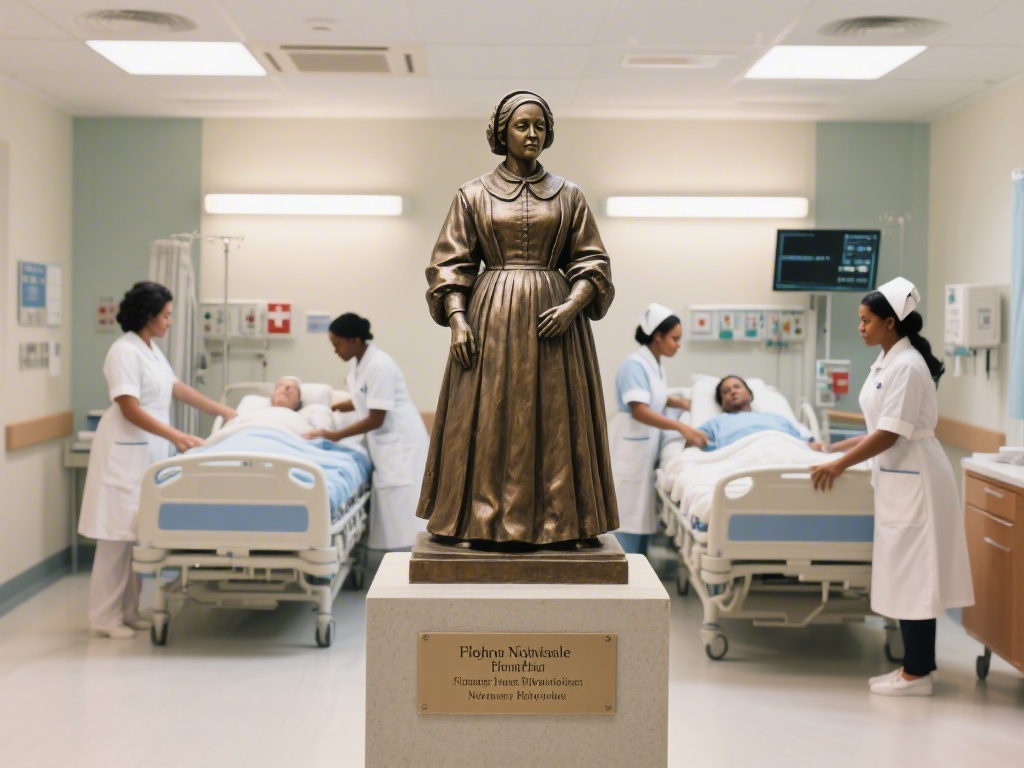
Most people recognize Florence Nightingale as the “Lady with the Lamp,” the gentle figure who cared for wounded soldiers during the Crimean War and founded modern nursing as we know it. But far fewer people can answer the common history question: how many years was Florence Nightingale a nurse for. As a former nursing educator who’s spent years researching her life and work, I can tell you the answer isn’t as straightforward as you might think. It all depends on how you define “nursing work,” and the distinction tells us a lot about why her legacy is still so relevant for healthcare workers today.
How Many Years Was Florence Nightingale a Nurse For? The Exact Timeline
Let’s start with the two most common calculations people use to measure her career length. If counting both direct patient care and lifelong nursing advocacy, Florence Nightingale worked in the nursing field for 59 total years. That timeline starts in 1851, when she completed her formal nursing training, and runs until her death in 1910, when she was still advising nursing leaders and public health officials from her home.
That’s not the answer you’ll hear from everyone, though. If you only count hands-on, in-person clinical nursing work, her career spanned just 5 years. That covers the period between 1851 and 1856, when she was working directly with patients first in a London care facility and later in the Crimean war hospitals. After 1856, she returned to England with a chronic illness that left her mostly bedridden for the rest of her life.
So which count is correct? Both are, depending on the context. If you’re asking about her time spent delivering direct care to patients, the 5-year number is accurate. If you’re asking about her total contribution to the nursing profession, the 59-year timeline is far more representative of her impact. Most nursing history programs teach both numbers, because they highlight two very different sides of her career.
Key Milestones That Shaped Her Nursing Career
To understand why both timelines matter, it helps to look at the most important moments of her professional life. She didn’t just stumble into nursing by accident; she fought for years to pursue the career she knew she was meant for, against strong opposition from her wealthy, upper-class family.
Here are the most important milestones that defined her work:
- 1851: Completed formal nursing training at the Institute of Protestant Deaconesses in Kaiserswerth, Germany, against her wealthy family’s wishes. Her parents saw nursing as a low-status job unsuitable for a woman of her social standing, and refused to support her choice for years.
- 1854: Led a team of 38 volunteer nurses to care for wounded British soldiers in Scutari, Turkey, during the Crimean War. She was asked to go after reports surfaced that soldiers were dying from preventable infections and neglect at far higher rates than they died from battle wounds.
- 1860: Established the Nightingale Training School at St. Thomas’ Hospital in London, the world’s first secular nursing school. The school set formal standards for nursing education, including structured classroom learning and supervised clinical practice, that are still used globally today.
- 1859: Published Notes on Nursing, the first foundational textbook for nursing education that is still referenced today. The book was written for both professional nurses and ordinary people caring for sick family members at home, and it broke down basic hygiene principles that were not widely understood at the time.
Her work in the Crimea cut soldier mortality rates from 42% to less than 2% in under two years. She didn’t achieve this with fancy medical treatments; most of her changes were simple, like cleaning the wards, laundering patient linens regularly, providing clean drinking water, and improving nutrition for soldiers. She tracked every change she made with detailed statistics, so she could prove exactly what was reducing deaths.
Notes on Nursing sold more than 10,000 copies in its first year of release. It was reprinted dozens of times in the 19th century, and translated into 10 languages within a decade of its release. Even today, many nursing programs assign excerpts to first-year students to teach them the core values of patient-centered care.
Why Her Short Clinical Career Changed Healthcare Forever
A lot of people are surprised to learn she only spent five years working directly with patients. How can someone with such a short clinical career be considered the founder of modern nursing? The answer lies in her unique combination of clinical experience, statistical skill, and advocacy talent.
She was one of the first people in healthcare to use data visualization to prove public health policy outcomes. She invented a type of polar area graph (often called a Nightingale rose diagram) to show British government officials that most soldier deaths in the Crimea were from preventable infections, not battle wounds. The visual format made the data impossible to ignore, and convinced Parliament to pass sweeping hospital reform laws just a few years after she returned home.
She also completely redefined what nursing as a profession could be. Before her time, nursing was mostly done by unskilled working-class women, and it was widely associated with drunkenness and misconduct. Most middle and upper-class women would never consider working as a nurse, because it would ruin their social reputation. Nightingale’s school changed that, by framing nursing as a respectable, skilled career for educated women, with clear ethical standards and professional requirements.
By 1900, there were more than 1,500 nurses trained at her school working in hospitals across the UK and the British Empire. Her education model was copied in countries around the world, including the United States, Australia, and India. Even if she never touched a patient after 1856, the systems she built would have impacted millions of people for generations.
I’ve had dozens of nursing students tell me they got into the field because they learned about Nightingale as a kid. What they don’t usually realize is that most of her most impactful work happened from her bed, after she was too sick to work in a hospital ward. That’s a reminder that you don’t have to be working directly with patients to make a huge difference in healthcare.
Common Misconceptions About Her Nursing Career
As with any famous historical figure, there are a lot of myths and false facts floating around about Nightingale’s career. These are the three most common ones I see repeated online and even in some school textbooks.
The first big misconception is that the “Lady with the Lamp” is an accurate representation of her work. The “Lady with the Lamp” nickname was created by British newspaper reporters, and Nightingale herself found the romanticized image distracting from her work. She hated being portrayed as a gentle, self-sacrificing caregiver, because that ignored the years of statistical work and policy advocacy that made her changes stick. She once wrote in a letter that the lamp image made her look like a “folk hero” instead of the public health researcher she was.
Another common myth is that her long illness was a fake, or that she used it as an excuse to avoid public appearances. Modern medical researchers have reviewed her symptoms and medical records from the time, and confirmed she suffered from chronic brucellosis, a bacterial infection she likely contracted from drinking unpasteurized milk in the Crimea. The condition causes severe chronic fatigue, joint pain, and recurrent fevers, which made it impossible for her to stand for long periods or travel. Even so, she worked 12 to 14 hour days from her bed, writing more than 200 reports, pamphlets, and letters to politicians and healthcare leaders over the course of her life.
Finally, a lot of people think she only cared about nursing for wealthy white women. That’s not true either. She wrote extensively about public health for poor working-class communities in the UK, and she advised health officials in India on how to reduce mortality rates from preventable diseases in rural villages. She also pushed for nursing training for Black women in the United States, and corresponded with Black nursing leaders in the US in the late 19th century to support their work.
It’s easy to reduce historical figures to one or two famous stories, but taking the time to learn the full context of their work makes their legacy far more meaningful. Nightingale was far more than a woman with a lamp walking through a hospital ward. She was a skilled statistician, a fierce advocate, and a trailblazer who fought to make healthcare better for everyone, no matter their social status.
At the end of the day, the answer to how many years was Florence Nightingale a nurse for depends entirely on how you measure her work. If you count only hands-on patient care, it’s 5 years. If you count her full contribution to the nursing profession, it’s nearly 60 years of impact that still shapes every nurse working today. If you’re interested in learning more about her work, pick up a copy of Notes on Nursing next time you see it. Even 160 years later, most of her advice is still just as relevant for caring for sick loved ones, or for understanding the core values of good healthcare.